

Medtronic

Darian

Medtronic TAVR patient
Main visual

Frequently asked questions (FAQ)

Transcatheter aortic valve replacement (TAVR) is a minimally invasive procedure to replace the aortic valve in patients with heart valve failure (severe aortic stenosis). TAVR is less invasive than open-heart surgery, and the procedure typically takes less than one hour. There is also pre-procedure prep and post procedure recovery. Your heart team will determine if you should have a mild sedative or general anesthesia.

At the start of the procedure, your doctor will make a small cut in one of three typically used access routes: a small cut in the groin (1), the neck (2), or a space between your ribs (3).

The doctor will guide a thin, flexible tube with the heart valve into your artery and to your diseased valve. Throughout the procedure, your doctor will be viewing images of your heart.

The Medtronic TAVR heart valve will be placed in your diseased valve. Your new valve will work immediately. Your doctor will remove the tube and close the cut.

After the procedure, most patients spend a few hours in the intensive care unit (ICU) before transferring to a patient room. Typically, patients begin walking the same day as their Medtronic TAVR procedure and are discharged within a day or two.

TAVR risks may include, but are not limited to, death, stroke, damage to the arteries, bleeding, and need for permanent pacemaker.
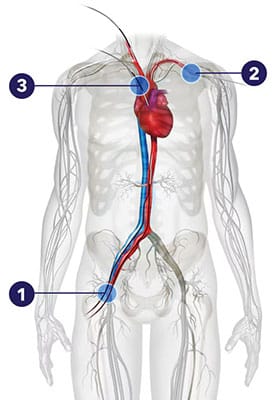
TAVR body anatomy 3 callouts

After the procedure, most patients spend a few hours in the intensive care unit (ICU) before transferring to a patient room. Typically, patients begin walking the same day as their Medtronic TAVR procedure and are discharged within a day or two.

Statistically, the answer is yes. Women with aortic stenosis are up to 35% less likely to be treated than men.1 Despite their longer life expectancy, once a woman is impacted by severe aortic stenosis, they suffer from higher mortality than men.2 However, if women do receive treatment, they have a lower mortality rate and excellent outcomes compared to SAVR.3

Actually, both men and women can benefit from the TAVR procedure and the use of Medtronic TAVR valve, Evolut™. The reason for pointing out Evolut’s value to women is that a recent clinical study showed superior valve performance for women receiving Evolut compared to the SAPIEN TAVR valve.4§ This study, the SMART Trial as it’s commonly known, focuses on health outcomes of patients with small heart valves, of whom approximately 87% were female.


Talk to your doctor to see if TAVR is right for you. TAVR may be a good option for you if you are having symptoms and if tests performed by your heart team show that it may be helpful. TAVR may also be an option for you if you are at risk for open-heart surgery. All severe aortic stenosis patients who are experiencing symptoms should be evaluated by a doctor for all of their valve replacement options, including TAVR.

While some patients take longer to feel better5, most TAVR patients start noticing a difference right away. This is because their heart valve is now working properly. Some of the most commonly reported TAVR patient benefits include:

  • Having more energy
  • Breathing normally
  • Experiencing less pain
  • Experiencing fewer symptoms
  • Feeling less anxious

TAVR risks may include, but are not limited to, death, stroke, damage to the arteries, bleeding, and need for permanent pacemaker.

More than 800,000 people worldwide have had a Medtronic TAVR procedure6 — offering patients the opportunity to return to their active lives.

A heart team is a specialized care team that includes interventional cardiologists, cardiac surgeons, imaging specialists, anesthesiologists, and other doctors as needed. Together, these experts work to identify and present the best treatment option for you.

A VPC is usually your first point of contact at a TAVR hospital. They will be with you throughout the TAVR journey to provide support and answer questions. They help with testing, reviewing treatments, follow-up after the procedure, and can even help with insurance-related needs.

No. Unlike open-heart surgery, TAVR does not require stopping the heart.

Designed to work like your own heart valve, the Medtronic TAVR heart valve offers a number of features that make it worth discussing with your heart team:

  • Its metal frame, a blend of nickel and titanium, allows the frame to shape itself to your anatomy.
  • The Evolut™ FX+ valve frame has gold markers beneath the outer wrap so your doctor can better see the valve on X-ray during the procedure.
  • The Evolut™ FX+ valve also has three larger cells to help your doctor access your coronary arteries.
  • The Medtronic TAVR heart valve comes in four different sizes.

Your doctor will check your valve during your regular follow-up visits.

You will be asked to return to the valve clinic to have your heart valve checked at 30 days and one year after your procedure, as recommended by your physician. If you have concerns, discomfort, or changes in your health, be sure to let your doctor know right away.

Discuss this with your doctor, and he or she can help you decide which activities are safe for you to continue after the TAVR procedure. Before you leave the hospital, your doctor will explain what activities you can do, what medications you need to take, and when you will need to see your doctor again. You will also be given an information card about your new TAVR heart valve.

If you need an MRI, tell your doctor that you have a Medtronic heart valve, as they will need to make changes before going through with your scan.

The Medtronic TAVR valve cannot be used for patients who:

  • Have a serious heart valve infection
  • Cannot take medications that reduce the risk of blood clots
  • Have a reaction to some metals

If the Medtronic TAVR valve is used in these patients, it will not work properly. This could make you feel sick or even cause death.

For some patients, the Medtronic TAVR procedure risks may outweigh the benefits. Please talk to your doctor to decide whether this therapy is right for you.

Selection icon

Is TAVR right for you?

Get help

Location icon

Find a heart team

Phone icon

Talk to our TAVR support team

Call us: 800-258-9220

† Medtronic TAVR is indicated to treat patients who have been diagnosed with symptomatic severe aortic stenosis.

‡ Valve performance is as defined as freedom from bioprosthetic valve dysfunction (BVD) through 12 months. BVD is defined as a composite including any of the following: hemodynamic structural valve dysfunction (mean gradient ≥ 20 mmHg), non-structural valve dysfunction (severe prothesis-patient mismatch or ≥ moderate aortic regurgitation), clinical thrombosis, endocarditis, and aortic valve reintervention.

§ Medtronic TAVR is indicated to treat patients who have been diagnosed with symptomatic severe aortic stenosis.

TAVR risks may include, but are not limited to, death, stroke, damage to the arteries, bleeding, and need for permanent pacemaker.


  1. Rice CT, Barnett S, O'Connell SP, et al. Impact of gender, ethnicity and social deprivation on access to surgical or transcatheter aortic valve replacement in aortic stenosis: a retrospective database study in England. Open Heart. September 2023;10(2):e002373.
  2. Tribouilloy C, Bohbot Y, Rusinaru D, Belkhir K, et al. Excess Mortality and Undertreatment of Women With Severe Aortic Stenosis. J Am Heart Assoc. 2021 Jan 5;10(1):e018816.
  3. Skelding, K.A., et al., Transcatheter Aortic Valve Replacement Versus Surgery in Women at High Risk for Surgical Aortic Valve Replacement (from the CoreValve US High Risk Pivotal Trial). Am J Cardiol, 2016. 118(4): p. 560-6.
  4. Tchétché D, Mehran R, Blackman DJ, et al. Transcatheter Aortic Valve Implantation by Valve Type in Women With Small Annuli: Results From the SMART Randomized Clinical Trial. JAMA Cardiol. Published online October 09, 2024.
  5. Placeholder for now.
  6. Medtronic Data on File.